

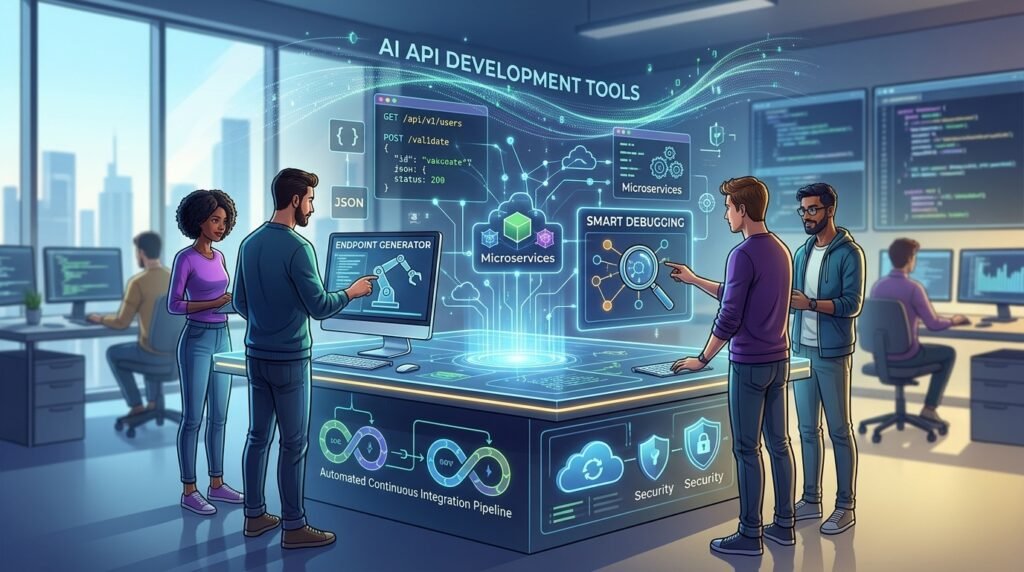
An expert guide exploring high-impact AI API development tools, automated endpoint generators, and smart developer ecosystems for modern tech stacks.
Modern software engineering requires deploying robust AI API development tools to accelerate backend architecture and streamline microservices communication. Developers must leverage automated endpoint generators, smart testing suites, and predictive debugging models to maximize software reliability.
In this guide, we explore essential technical integrations, high-performance API scaling benchmarks, and practical implementation tips using advanced AI API development tools to help engineering teams build secure and maintainable systems.
Core AI API Development Tools for Modern Software Engineers
Executing successful backend scaling initiatives with AI API development tools empowers development teams to eliminate manual boilerplate coding, enhance endpoint security, and drive high-speed feature delivery. Modern engineers expect automated schema documentation, instant mock servers, and real-time syntax checking to manage backend operations smoothly.
To achieve sustainable development velocity, technical leads must optimize their deployment pipelines, utilize AI-driven code refactoring assistants, and refine performance monitoring methodologies continuously.
Furthermore, implementing top-tier AI API development tools prevents version control conflicts and ensures seamless integration across distributed cloud architectures.
Adopting these structured optimization frameworks guarantees that growing engineering units maintain a competitive technical edge and secure higher system uptime.
Additionally, monitoring real-time telemetry helps developers identify latency bottlenecks before they impact production environments.
Engineering squads can effortlessly synchronize API documentation portals with automated testing frameworks to manage code quality efficiently.
Comprehensive performance analytics further allow tech leads to track request payload sizes and fine-tune resource allocation.
Utilizing proper guidelines for AI API development tools ensures long-term code maintainability and high performance metrics across all software layers.
Scaling software infrastructure becomes significantly streamlined when teams adopt automated continuous integration workflows and centralized schema registries.
Generate functional mock servers instantly from OpenAPI specifications without manual coding.
Identify payload anomalies and runtime exceptions proactively using intelligent analysis models.
Ensure strict compliance with data contracts across microservices seamlessly.
Detect vulnerabilities and authorization flaws early in the software development lifecycle.
Comparison of Top AI API Development Tools
Evaluate core software engineering solutions based on integration speed, feature scalability, protocol flexibility, and overall system impact.
| Tool Category | Primary Focus | Implementation Effort | Impact |
|---|---|---|---|
| AI Code Assistants | Boilerplate reduction & syntax generation | Low | Very High |
| Automated Testing Suites | Endpoint load & security validation | Medium | High |
| Schema Registries | Contract management & versioning | Low | High |
Detailed Platform Review
Next-Gen API Ecosystems — Deep Dive
Modern engineering teams rely heavily on integrated development platforms to automate routine coding tasks and monitor system metrics. Official developer documentation and API integrations can be explored directly on the GitHub Developer Portal for advanced configurations.
Pros
- Drastically reduces manual boilerplate development time
- Improves API consistency and cross-service communication
- Provides deep analytical insights into request latency patterns
Cons
- Initial tool integration requires developer onboarding time
- Cloud subscription fees can scale with enterprise request volumes
Final Verdict on AI API Development Tools
Adopting proven AI API development tools is essential for software organizations aiming to scale robust microservices in a competitive market. By streamlining backend workflows, leveraging automated testing, and utilizing modern architecture frameworks efficiently, your engineering team can achieve long-term code reliability.
Furthermore, continuous evaluation and data-driven adjustments will safeguard your systems against evolving security threats and performance demands.
Recommended Resources
Discover More Developer Tools
Find, compare, and scale your tech stack with our curated directory of top-tier software solutions.
Explore AI Niche Tools →